COE Spotlight: April Hill-Jackson, Meharry Medical College
For April Hill-Jackson, community engagement is a deeply personal mission rooted in professional responsibility, empathy, and…

For April Hill-Jackson, community engagement is a deeply personal mission rooted in professional responsibility, empathy, and a commitment to making sure everyone has equal access to healthcare.
As the Community Engagement Coordinator for clinical trials at Meharry Medical College, Hill-Jackson works at the intersection of research and community trust, helping ensure that clinical trials reflect the different populations they are meant to serve. Her path to this role has been anything but linear, and every step has shaped the way she approaches her work today.
Connecting with Communities
April’s professional journey began during her undergraduate studies in international communication, where she specialized in working with nonprofit organizations. Through overseas experiences in both Paris and Wales, she learned how to engage communities across different cultural contexts, whether it be speaking with individuals on the street about nonprofit initiatives or interviewing Caribbean migrants from the Windrush generation.
“These interactions taught me that every conversation has to be tailored to where a person is coming from,” she explained.
That lesson became even more critical during her time at TikTok, where she worked on the political misinformation and disinformation team. There, she observed how people process information, including health and medical content, and how gaps in institutional messaging and public understanding can lead to mistrust.
Those insights now inform her work at Meharry, where she focuses on connecting people to clinical research in ways that feel relevant, accessible, and trustworthy.
Why Representation Matters
At the heart of Hill-Jackson’s work is a simple but powerful principle: representation matters at every level.
In clinical trials, she explains participants need to see themselves reflected, not just in the data, but also in the people apart of the research team.
“Participants want someone who can relate to their background and explain how a study affects their life and community,” she said. Representation matters, she added because participants are often more likely to trust and relate to someone who shares their background and experiences.
This is especially important in communities that have historically been underserved or mistreated by the medical system. Hill-Jackson often draws on that history to explain why participation in clinical trials is essential for fairness as well as better health outcomes.
“When community engagement is thoughtful and intentional, it respectfully addresses any concerns people have,” she noted.
Her role, in part, is to act as a translator, bridging the gap between scientific research and everyday understanding. By meeting people where they are, both culturally and emotionally, she works to make clinical research feel more relevant and meaningful.
The Beacon of Hope Effect
The Beacon of Hope investment in Meharry marked a turning point for Hill-Jackson.
Prior to Beacon of Hope, community engagement efforts were stretched thin at the institution. Competing priorities and outreach efforts felt fragmented. The initiative’s funding, however, provided a means for structure, strategy, and a new perspective that helped align their work.
“It gave us a new appreciation for our capacity and the urgency of where we need to go,” Hill-Jackson said.
Through onsite collaboration and guided planning, support from Beacon of Hope helped the team plan strategically, develop clearer timelines, set measurable goals, and identify opportunities that may have been missed previously. Just as importantly, it elevated the importance of community engagement across the organization, demonstrating the potential for a broader and more meaningful impact of their collective efforts.
“After Beacon of Hope, everyone at the center better understood the importance of my role and what we need to do to get on one accord,” she shared.
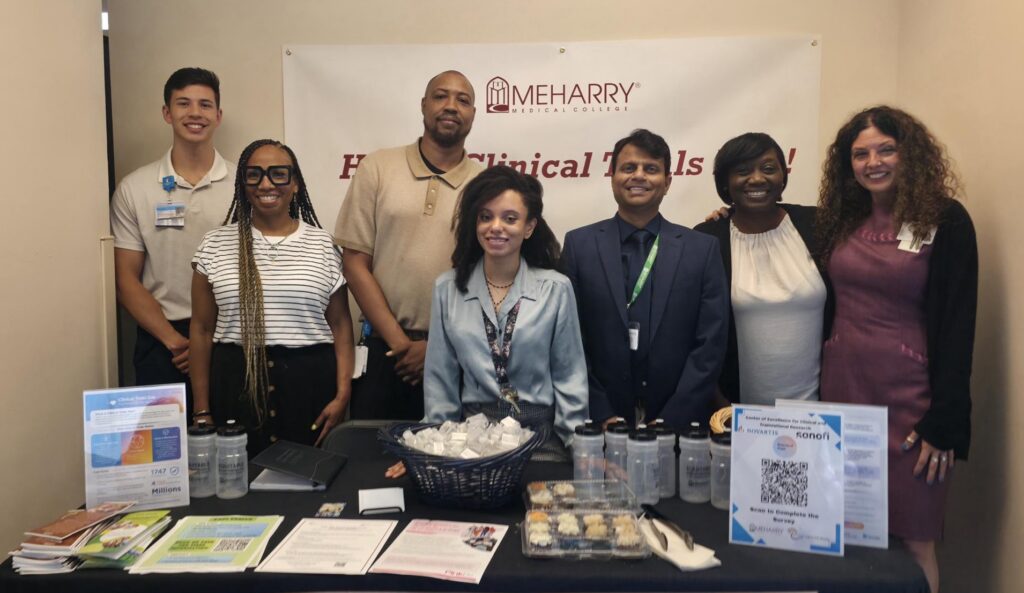
The impact has been tangible. With a more cohesive strategy, the team expanded its outreach through events like Juneteenth celebrations in Nashville, where conversations about health and research can happen naturally within trusted community spaces.
Reaching People Where They Are
Hill-Jackson’s approach to engagement is both strategic and creative. From word-of-mouth campaigns, local festivals, and online forums, she is exploring new ways to connect with communities.
Finding those connections might mean sharing information about clinical trials at a neighborhood street festival, hosting an online Q&A, or amplifying awareness through local media. For Hill-Jackson and her team, it’s about meeting people where they are, physically, culturally, and emotionally.
Currently, Ms. Hill-Jackson is planning an event with Story Corps, where members of the Meharry Beacon of Hope Center of Excellence will be interviewed for recordings that will be saved in the Library of Congress.
Looking ahead, she envisions expanding these efforts beyond Nashville, building deeper relationships locally while gradually scaling efforts to reach broader regional and national audiences.
A Personal Mission
What drives April the most, however, is personal.
As a woman of color, a member of the LGBTQ community, and someone who identifies as having a disability, she brings a deeply informed perspective to her work. She has seen firsthand how systems can fail marginalized groups and she is committed to changing that.
“I have boundless empathy for many groups. I know that I am intimately aware of the ways that people are ignored, the ways that people are left in the margin.” she said.
For her, community engagement is not just a strategy, it’s the foundation for better clinical research, better policy, and more comprehensive care for all.
“If you’re not bringing the public into what you’re doing, it falls apart,” she said. “Community engagement is the core of these things.”
In partnership with Beacon of Hope, Hill-Jackson is helping ensure that clinical trials are not only scientifically rigorous, but also inclusive, responsive, and rooted in trust.
In doing so, she is helping build a future where every community has a voice in the science that shapes their health.